Applications
Where spinner knobs are used
A suicide knob is a one-hand steering aid. The same idea shows up on vintage cars, adaptive driving equipment, forklifts, farm machines, and some boat helms.
Passenger cars and light trucks
On cars, the classic use was to speed up parking and cornering before power steering. A driver could crank lock-to-lock without climbing hand-over-hand around a large, heavy wheel.
After power steering became standard, decorative knobs stayed on as a period accessory. Some people still fit them on older cars for one-hand driving at low speed. Highway use is a different question: modern cars already steer lightly, and a protruding knob changes how the wheel behaves in a sudden maneuver. See safety.
Adaptive driving
Spinner knobs are a standard adaptive aid for drivers who steer with one hand — including people who use hand controls, have limited use of an arm, or hold a restricted license that calls for a steering aid.
Mobility versions are built as driving equipment, not novelties. Common shapes include:
- Ball or mushroom knobs for a closed fist
- Tri-pin and V-grips that locate the hand
- Palm grips
- Amputee rings
Some states require a steering aid on a restricted operator’s license. New York, for example, requires an aid on the steering mechanism for some drivers with a disability. Michigan has noted that a spinner could be required under a restricted license. Those notes are collected on the laws page.
Forklifts and industrial trucks
Forklift work is mostly tight turns in a small aisle. A spinner lets the operator keep one hand on the wheel while the other works lift, tilt, or horn controls. Many factory trucks ship with a knob, or with a mounting point for one.
Workplace rules can still apply. OSHA restricts spinner knobs on some construction material-handling machines unless the steering cannot kick back and the knob sits inside the rim. Manufacturer approval can also matter before anyone adds an aftermarket knob to industrial equipment.
Tractors, mowers, and construction machines
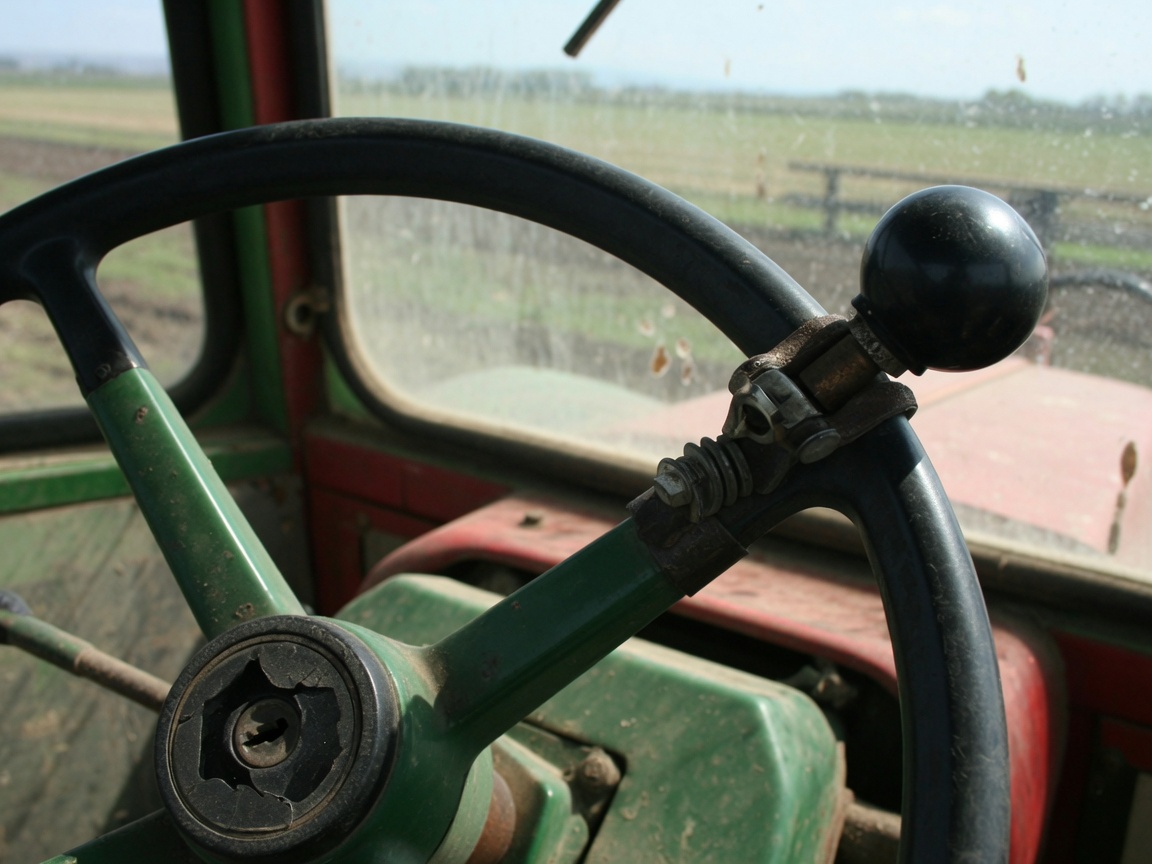
Farm tractors, riding mowers, loaders, and similar machines use knobs for the same reason: frequent lock-to-lock steering, often while the other hand runs a throttle, three-point hitch, or mower deck. Ice resurfacers and some other specialty machines use them too.
On construction equipment that hauls and handles materials, federal OSHA rule 1926.602(c)(1)(iv) is the usual citation. Oregon’s construction rules follow the same idea: power steering, and the knob placed inside the periphery of the wheel.
Boats
Some powerboat helms include a stainless wheel with a spinner, or accept one as an accessory. The job is the same: spin the wheel quickly at low speed when docking or working in a tight basin.
Highway trucks
Spinners have a long history in truck cabs from the unassisted-steering era, when a driver might steer with one hand and shift with the other. They still appear, but company policy, inspection practice, and equipment rules can be stricter than passenger-car statutes. There is no single federal ban by name. Inspectors may still treat a loose, protruding, or poorly mounted knob as an unsafe steering component. Many fleets prohibit them.